Why Machine-Translated Chinese Reads Wrong: an Open-Source Transcreation Method for AI Agents
TL;DR: Machine-translated Chinese is usually accurate word by word and still reads like a translation, because it keeps the English sentence shape. zh-transcreation is an open method (CC BY 4.0) that makes AI agents write Chinese from a brief instead of translating sentences. It works in Claude Code, Cursor, Codex or any LLM.
The problem: correct words, wrong language
Here is a line any marketing site might run:
Ready to unlock your business's full potential? Our comprehensive solutions empower you to maximize local visibility.
A literal translation gives you 准备好释放您业务的全部潜力了吗?我们全面的解决方案赋能您最大化本地可见性。 Every word maps back to the English. No Chinese business owner talks like that. A native reader notices within a sentence, and the page loses the trust the English version earned.
The transcreated version is 想让附近的人搜得到你?网站、Google 商家、小红书,我们一起帮你做。 Roughly: "Want people nearby to find you? Website, Google Business Profile, Xiaohongshu: we'll do it with you." It keeps the intent (be found locally) and drops the English syntax, the abstract nouns and the sales voice.
If you run a bilingual business, or you localise products into Chinese, you have seen the first version many times. It comes from human literal translation and from LLMs alike.
Why LLMs produce translationese
Models translate English into Chinese sentence by sentence, so the output inherits English structure:
- Passives where Chinese would use an active verb with a person as subject.
- Long pre-nominal modifiers, because English relative clauses get folded in front of the noun.
- Pronouns everywhere (您, 您的, 我们的), where Chinese drops them.
- Nominalisations: "the deployment of AI brings an improvement in response speed" instead of "with an AI assistant, replies come faster".
- Connective stacking (从而, 并且, 因此), where Chinese relies on word order.
Adding "make it sound natural" to the prompt barely moves the needle. Li et al. (ACL 2025, Lost in Literalism) found that about 45% of LLM English-to-Chinese documents show translationese, and that a translate-then-polish pass cut the share of clearly translationese GPT-4 documents from 43% to 25%. The output can be fixed, but only with specific instructions rather than a general request for fluency.
What we changed on our own site
On 2026-10-18 we applied the method to nextagent.ca's Chinese site: 67 pages. Prices, numbers and links stayed as they were. The problems were typical:
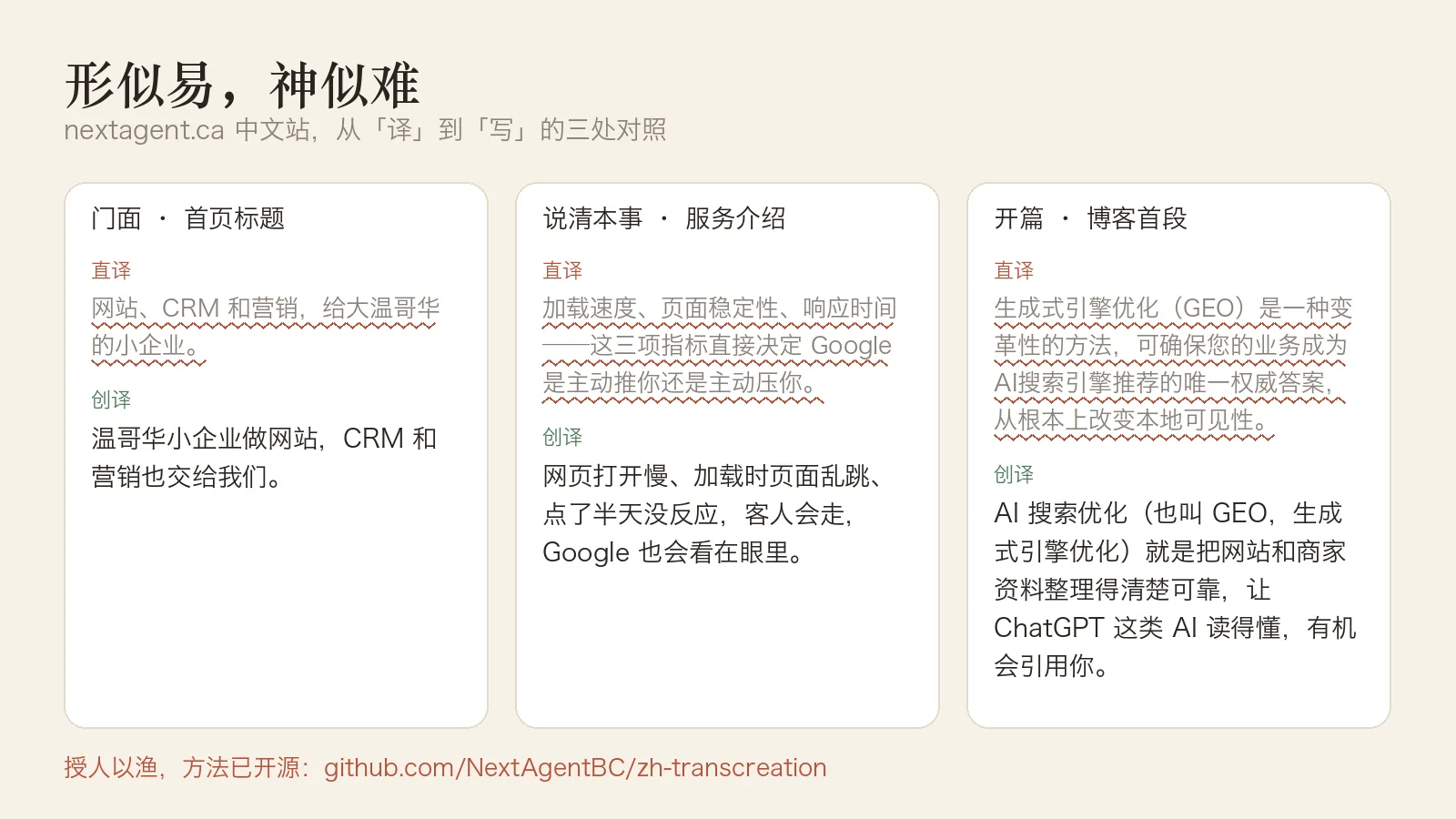
- Headlines copied the English "X, for Y" pattern and lost the words Chinese customers search for. The home H1 went from "websites, CRM and marketing, for Metro Vancouver small businesses" to "Vancouver small businesses: get your website built, and hand us CRM and marketing too", with 温哥华 and 做网站 up front.
- Service copy stacked metric nouns ("load speed, layout stability, response time directly decide whether Google promotes or buries you"). That was abstract, and it overclaimed on a page that elsewhere says no one can guarantee rankings. The rewrite describes what a customer sees: a slow page, a jumping layout, a button that doesn't respond.
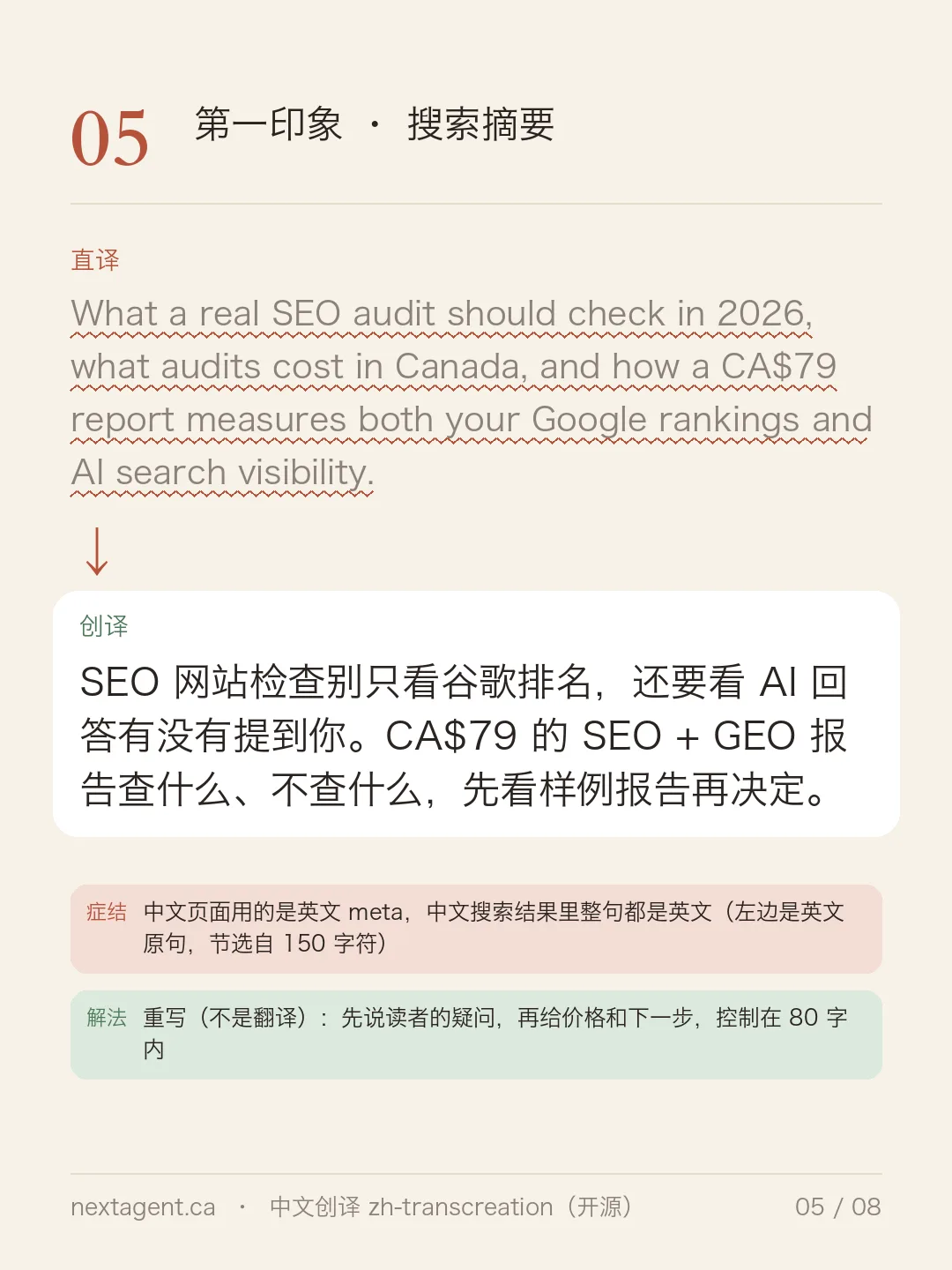
- Meta descriptions on Chinese blog posts were still in English, so Chinese search results showed English snippets. Each one was rewritten in Chinese, under 80 characters, starting from the reader's question.
- Absolute claims such as "your data never touches the public cloud. Uncompromising." became a promise we can keep: the AI runs in your own server or account, and the data stays in your name.
The method in brief
The framework borrows from translation theory. Skopos theory (Vermeer, with Nord's loyalty principle) sets the direction: decide the reader and the purpose first. Nida's dynamic equivalence and Newmark's communicative translation set the standard: the Chinese reader should react the way the English reader did. Venuti's domestication sets the default: Chinese settings and Chinese phrasing. Loyalty is the floor: facts and the scope of any promise do not change.
In practice it runs as six steps:
- Write a brief, not Chinese. Reader, the action you want, the core message, and a fact list (prices, numbers, dates, what is not promised).
- Chinese reader and search. One primary keyword, a few long-tail variants, and the questions customers actually ask, which become H2s and FAQ.
- Write from the brief only. The model never sees the English sentences, so there is nothing to copy.
- Remove translationese. Run a 30-point checklist, then ten English-Chinese contrasts (hypotaxis to parataxis, static to dynamic, impersonal to personal subjects, passive to active, abstract to concrete), then a separate trimming pass that cuts 10–20% of the characters.
- Keywords and GEO. Place terms in the title, opening, at least one H2, a Chinese meta description and the FAQ, so both Google and AI answer engines can find and quote the page.
- Proofread. Check every fact against the list, scan for banned compliance phrases, and have a native reader score it. No back-translation.
A few checklist items, to give the flavour: drop 当……时 ("when...") clauses; replace 进行 + noun with a real verb; stop translating every pronoun; swap empty intensifiers for a number from the fact list or delete them; replace marketing verbs (打造, 赋能, "empower") with what actually happens.
Tiered elegance
Chinese readers value 雅, a kind of restraint and allusion that English marketing copy rarely aims for. The method allows it in layers. Titles, taglines and cards may use an idiom; body text, prices, terms and FAQ stay plain and searchable. The title formula is "image or idiom + a literal half that carries the keyword", for example 酒香也怕巷子深 ("even good wine needs to be found down a deep alley") followed by the actual service description. The rule is to add colour occasionally and never for its own sake: five or six idiom headlines across a whole site, reserved for the pages that matter.
Install and use
Claude Code plugin:
claude plugin marketplace add NextAgentBC/zh-transcreation
claude plugin install zh-transcreation@nextagent
Cursor: copy the rule file from adapters/cursor/ into .cursor/rules/. Codex: append adapters/codex/AGENTS.md to your project's AGENTS.md. Any other LLM: paste the generic system prompt, or run the prompts in prompts/ as separate calls (outline, write from outline, review and trim) and finish with code checks.
Give the agent the English source, who the Chinese reader is, what you want them to do, and the channel (website, blog, Xiaohongshu). It returns a brief for you to approve before it writes.
The default setting is Chinese-speaking small-business owners in Metro Vancouver. For another market, swap currency, place names, holidays and keyword sources.
Repository: github.com/NextAgentBC/zh-transcreation. More of our open work is on the open-source page.
Credits
The method stands on Yan Fu (信达雅: faithfulness, clarity, elegance), Fu Lei (resemblance in spirit over form), Qian Zhongshu (化境, translation the reader cannot detect), Yang Jiang (点烦, trimming the redundant), Xu Yuanchong (the three beauties), and on Nida, Newmark, Venuti, Vermeer, Reiss and Nord. Full sources are listed at the end of method.md.
Need a Chinese site that reads like Chinese?
We build bilingual English-Chinese websites and marketing for small businesses in Metro Vancouver, and the Chinese is written with this method. Book a free 30-minute consultation, or start with the CA$79 SEO + GEO report to see how your site shows up on Google and in AI answers.